
What a 39-year-old competing at Wimbledon can teach us about the metric that actually matters for how we age.
TL;DR
- Lifespan counts the years. Healthspan is the quality inside them. Most people are optimizing for the wrong metric.
- Compression of morbidity is the goal. The aim isn't to live forever — it's to stay well for as long as possible, and to keep the period of decline as short as possible.
- Djokovic at 39 is a case study in what a well-tended body can do. His longevity isn't luck — it's the result of treating sleep, nutrition, recovery, movement, and mental conditioning as a unified system.
- The pillars are universal. The same lifestyle levers that keep Djokovic competing at the highest level of professional sport are the ones that protect healthspan for everyone.
- Knowing what to do is the easy part. Doing it consistently is the gap. Ucardia's care team and Arny help members turn the right principles into daily habits that compound over time.
The Metric Most People Are Missing
Last Friday, Novak Djokovic walked off Centre Court at Wimbledon having just lost a semifinal to the world's best player, Jannik Sinner. He was beaten in straight sets. And yet the story being told wasn't about defeat — it was about defiance.
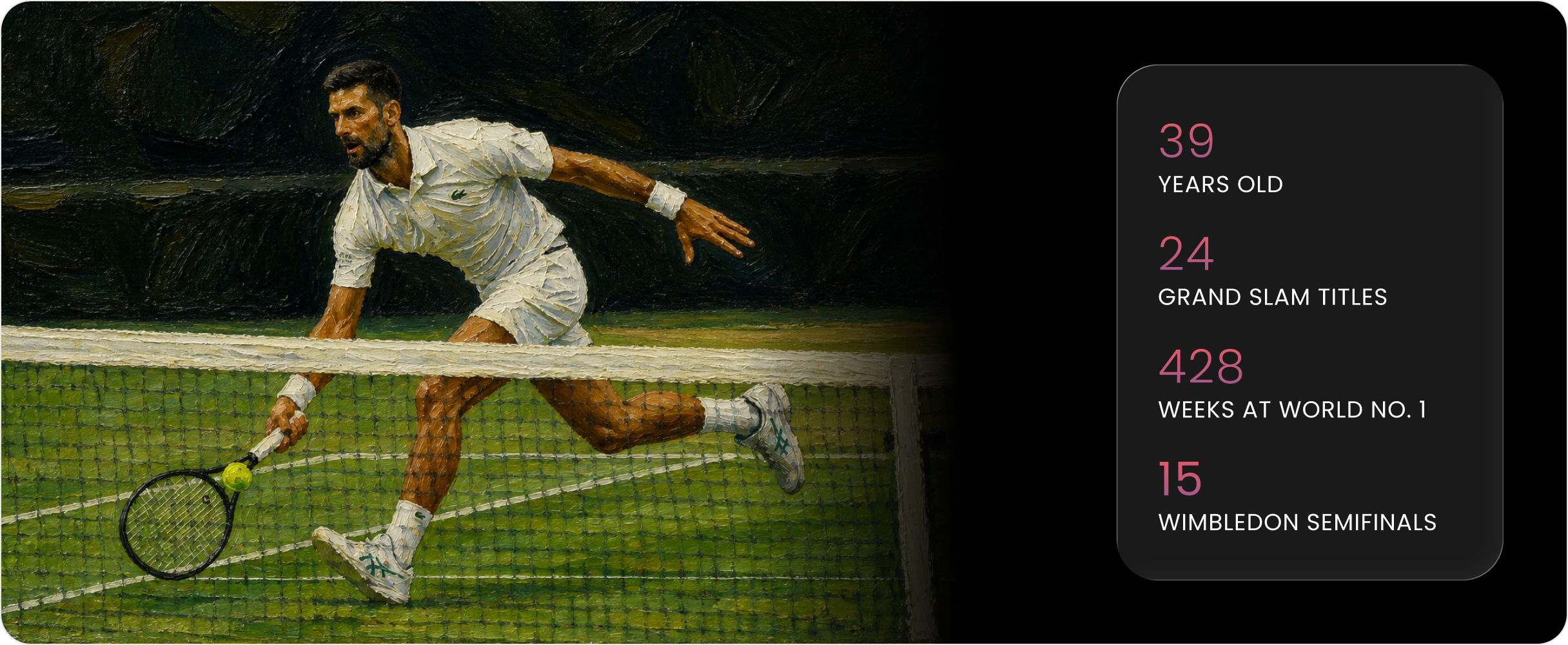
Djokovic is 39 years old. He is competing at the highest level of professional tennis against men who were in elementary school when he won his first Grand Slam. He reached the Wimbledon semifinal this year for what feels like the hundredth time, because for all practical purposes, it is. He is one of the most decorated athletes in the history of sport, and he is still here — still moving, still competing, still demanding everything from his opponents.
We tend to look at someone like Djokovic and call it a gift. Genetics. Talent. Luck. But that framing misses the real story — and it misses a distinction that matters far more than how long we live.
Most of us think about longevity as a single number: how many years do we get? That's lifespan. But the more important question is: how many of those years are you actually well? How many are you mobile, sharp, energized, and capable of doing the things that matter to you? That's healthspan — and it's what Djokovic has optimized his entire life around.
The average person in the developed world lives into their late 70s or early 80s. But a significant portion of those final years is frequently marked by chronic disease, cognitive decline, reduced mobility, and dependency. We've added years to life without necessarily adding life to years. The goal of modern longevity care is to close that gap — to compress the period of decline, to stay well until close to the end, rather than spending years simply enduring.
Djokovic isn't just still playing tennis at 39. He's playing it at an elite level, recovering from matches faster than many players a decade younger, and showing up mentally locked in for every point. That's what an optimized healthspan looks like in practice.
The Five Pillars Djokovic Actually Lives By
What's remarkable about Djokovic isn't that he has one unusual secret. It's that he treats his body as a system — and he tends every part of it with intention.
Nutrition as foundation. After a diagnosis of gluten and dairy sensitivity in 2010, Djokovic overhauled his entire approach to food. He now eats mostly whole, plant-based foods — gluten-free, dairy-free, free of refined sugar. His days start with warm water, lemon, and electrolytes. His meals are nutrient-dense and intentionally front-loaded earlier in the day. He supplements with vegan protein and creatine to support his training load. This isn't deprivation; it's precision fueling designed to support a body that has to perform at the highest level, year after year.
Sleep as performance. Eight hours, non-negotiable. Djokovic has spoken repeatedly about sleep as the single most underrated factor in recovery and performance. His evenings are structured with care — winding down, managing light exposure, treating rest as training rather than downtime. The body adapts during recovery, not during effort. He takes that seriously.
Recovery as seriously as training. Contrast therapy — alternating between sauna and ice baths — is central to how he maintains his physical capacity across a full season. Sauna supports circulation; cold exposure blunts inflammation and accelerates muscle repair. What most athletes treat as optional extras are, for Djokovic, core to the system that keeps him functional year after year.
Mental conditioning. Djokovic meditates. He visualizes. He practices mindfulness not as a wellness trend but as a competitive tool — building the resilience to stay composed on a critical point at Wimbledon when the pressure of the moment is at its highest. The mind ages too. He trains it accordingly.
Movement diversity. Beyond tennis, Djokovic swims, hikes, bikes, and jogs. He treats general physical fitness as the foundation on which his sport-specific performance sits — not the other way around. A broader base means more resilience, and more resilience means a longer career.
The through-line across all of it: he doesn't try to push past his body's limits. He tries to understand and respect them.

What This Has to Do With the Rest of Us
You don't need to be a professional athlete to apply the logic Djokovic lives by. Most of us won't play competitive tennis into our late 30s. But we will — if we're fortunate — live into our 70s, 80s, or beyond. And the choices we make now have an enormous bearing on what those years actually look and feel like.
The science on this is consistent and increasingly hard to ignore. Chronic disease — cardiovascular disease, type 2 diabetes, many cancers, dementia — is substantially driven by modifiable lifestyle factors. Sleep deprivation accelerates cognitive decline. Chronic inflammation, often dietary in origin, is implicated in nearly every major age-related disease. Sedentary behavior atrophies the muscle mass we need to stay mobile and independent.
None of this is destiny. Healthspan is, to a remarkable degree, trainable.
The pillars that work for Djokovic are the same ones the science points to for everyone, scaled to our own lives and goals. Eating mostly whole, unprocessed foods and reducing refined sugar and ultra-processed products. Prioritizing sleep as the biological necessity it is, not a variable to cut when life gets busy. Moving every day — not just structured exercise, but simply keeping the body from being stationary for hours on end. Managing stress actively, because chronic psychological stress is a direct contributor to accelerated aging. And recovering deliberately, because the adaptations that improve health happen during rest, not during effort.
These are not complicated interventions. They are consistent ones. And consistency over years is where the compounding effect of a well-tended healthspan becomes most visible.
The Gap Between Knowing and Doing
Most people already know the broad strokes. Eat better. Sleep more. Move regularly. Manage stress. The challenge isn't information — it's implementation. And implementation is where most wellness approaches fall apart, because knowing what to do in the abstract and knowing what to do for you, today, given your data and your life are two very different things.
This is exactly the gap Ucardia was built to close. Our care model pairs members with health coaches and dietitians who help translate the right principles into a personalized plan — grounded in each member's biomarkers, lifestyle, goals, and history. The human care team provides the clinical depth and the coaching relationship. That foundation doesn't change.
Arny, the AI-powered companion built into the Ucardia app, serves as a copilot in care in between those touchpoints. When a member wants to understand what their hs-CRP result means for their long-term cardiovascular risk, Arny explains it in plain language. When they need an activity plan on a Saturday morning, Arny can build one. When they want to know whether their sleep data from the past two weeks is trending in the right direction, Arny can pull it together and tell them what it means. Arny handles the always-on questions and the in-the-moment guidance, so the care team can focus on what they do best: deep coaching, complex behavior change, and the personalized support that drives lasting outcomes.
Together, they give members something that has historically been rare: continuous, personalized support through every dimension of long-term health — not just cardiovascular, but metabolic, cognitive, sleep, nutrition, mental wellness, and mobility.
That's what whole-person longevity care actually looks like.
The Deeper Point
Watching Djokovic at Wimbledon this year, it was easy to focus on the loss. Sinner is younger, faster, and at the peak of his powers. That's not going away. But Djokovic competing at a Grand Slam semifinal at 39 — moving fluidly, competing fully, demanding everything from his opponent — isn't a story about a player past his prime. It's a story about what's possible when someone spends decades investing in their health with the same seriousness they bring to their craft.
He will almost certainly retire soon. But when he does, it will be on his terms — not because his body gave out, but because the competition at the very top of professional tennis eventually outpaces even the most well-maintained human biology.
That's the goal. To arrive at your limits having fully used what you were given. To stack the years with quality, not just quantity. To make the choices today that protect how you feel — and what you're capable of — a decade from now.
Lifespan is the number of years you live. Healthspan is the quality of life inside those years. Djokovic has spent his career optimizing one while the world focused on counting the other.
The rest of us have more in common with him than we think — and more agency over our own healthspan than most of us realize.
Request a demo to bring Ucardia to your population, or download the app to start your own journey today.
